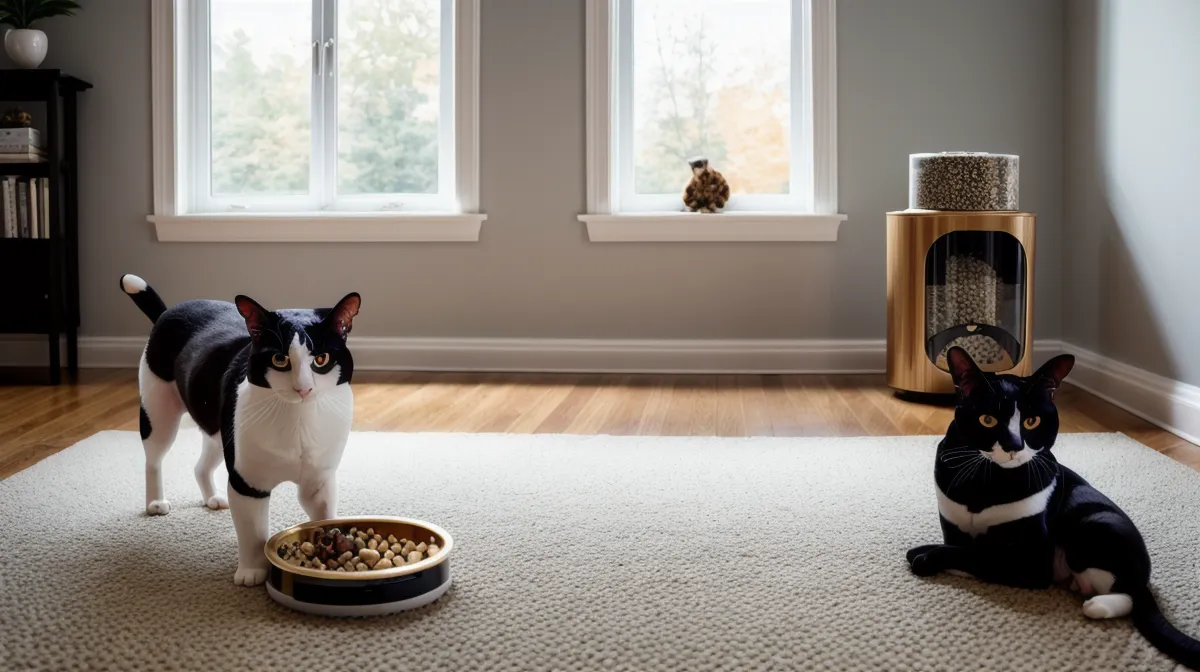
A bargain gravity feeder and a real smart feeder promise the same outcome: food drops on schedule without you standing there. Only one of them turned into a free-for-all the moment Hopper leaned his whole nine-year-old body against the chute and dumped three days of kibble across the linoleum in under a minute. That's the gap automated cat feeding is supposed to close, and it's why every feeder that comes through this two-cat apartment now goes through the same reliability checks — basic smart-home setup, multi-cat handling, the works — before it earns a permanent spot on the counter.
Quick disclosure up front: some of the pet brands mentioned here pay a commission when a reader clicks through and buys, at no extra cost to you. Every feeder gets bought with my own card, run through a full test cycle, and either stays in rotation or gets boxed up and returned. A brand dropping its affiliate program later doesn't change whether Hopper and Beans actually approved of the thing.
I Run Every Feeder Through the Same Reliability Checks
Suki, a reader who emails fairly often about her two tabbies, asked exactly how a feeder "passes" a test with me — she runs a strict schedule around ten-hour hospital shifts and wanted the actual checklist, not a vague thumbs-up. Fair question. Before any unit gets trusted with an empty apartment, it clears four separate categories, and the Petkit is the one currently living on my counter because it cleared all four. Whether a chute jams under load is a mechanical question with its own answer, separate from whether a determined cat can pry a lid open once he's found the weak spot — Hopper's already proven he'll try the second one given the chance. Portion accuracy is a different test again: does the unit drop the exact fraction it claims, meal after meal, without drifting. And with two cats eating different food, keeping Beans out of Hopper's bowl is a setup problem that has nothing to do with any of the above.

Why the 2.4GHz Band Trips Up First-Time Setups
Setup trips up more first-timers than the feeder's mechanics do. The unit only talks to a router over the 2.4GHz Wi-Fi band, not the faster 5GHz one most routers hand new devices by default, and that detail lives buried in the manual instead of on the box. Point it at the right band once and the connection holds steady — how it holds up under real stress, dropped routers included, is a separate test I've run in more depth elsewhere.
What Happens When the Power or the Wi-Fi Actually Drops
Old rental wiring flickers more than I'd like. The one time it mattered mid-project, the laptop died and the feeder didn't — it carries its own battery backup that keeps the clock and motor running when power or Wi-Fi disappears, something covered in more depth in my guide to battery backup reliability. Whether a unit can still dispense a scheduled meal with the internet completely gone is a related but separate resilience test, and it's one every feeder has to clear before it earns a spot on the counter.
Camera check-ins are their own problem entirely. The hub's status light runs a steady blue day to day, and one afternoon it switched to amber halfway through a feeding cycle, with no error message to explain why. The night it actually mattered, a two-a.m. notification had nothing to do with food at all — it was the camera announcing it had quietly slid off the network hours earlier, which meant the only proof a meal had happened was an empty bowl the next morning. My neighbor Clint, who doesn't own a single piece of smart gear for his own dog, asked why anyone pays a monthly fee just to watch a cat chew. No clean comeback for that. Just the want for proof a meal actually landed.
Bowl Hygiene, Notification Speed, and Food That Won't Go Stale
Bowl material matters more than it sounds like it should. Plastic scratches microscopically over time and those scratches trap bacteria, which shows up as chin acne on cats prone to it — Beans is one of them. The stainless bowl on this unit rinses clean the way a good frying pan does, nothing working into invisible grooves, and it's a real part of why this feeder holds a 4.4 average user rating.

Notification speed turned out to matter just as much as expected. Alerts hit my phone within seconds of a feeding, where the Petlibro units I've tested (solid for the price, just slower) sometimes take thirty to sixty minutes to push the same alert. That gap is nothing when you're home. It's everything when you're an hour into a client call and the only thing standing between you and a mid-meeting panic is a banner on a lock screen.
None of this applies if wet food is on the menu instead of dry — that adds a spoilage clock this unit isn't built to manage, and it's a different piece of gear and a different test entirely. Desiccant packs handle ambient humidity inside the hopper so kibble doesn't go soft and stale, which is its own maintenance habit worth tracking on a schedule. And for anyone running a fountain alongside a feeder, hard tap water will chew through a filter faster than the box promises, a maintenance question completely separate from anything covered here.
Timing Precision for a Crepuscular Cat
Cats are naturally crepuscular — hungriest at dawn and dusk — which matters more than trivia once a cat is on a strict medical or portion-controlled diet. A missed window isn't just a cranky cat; it can throw off an entire day's routine for an animal whose feeding needs to land close to on time. This is where the precision gap between feeders actually shows up: a schedule set for a specific time needs to fire at that time, not somewhere inside a loose window, and that consistency separates a feeder worth trusting from one that's merely good enough. There's a full setup for my picky ragdoll mix that walks through dialing in those exact micro-portions, if that's the specific problem being solved.
Which Feeder Wins for a Long-Absence Household
For a household gone eight to twelve hours at a stretch, with a cat who reacts badly to a missed meal, the Petkit Editor's Pick earns the counter space and has stayed plugged into the power strip behind the couch through winter, spring, and now summer. It cleared the jam test, the tamper test, the dead-battery test, and the two-a.m. camera test without a single missed feeding that traced back to the hardware itself. If a cat isn't the type to lean on a chute and the budget has a hard ceiling, the Petlibro holds up fine on portion accuracy, and the trade is real savings for slower notifications and a bowl that needs more scrubbing. That gap is worth the extra fifty bucks if a missed alert during a client call would actually cost something. Check the router's band settings before plugging anything in, so nobody spends twenty minutes yelling at a router the way I did.