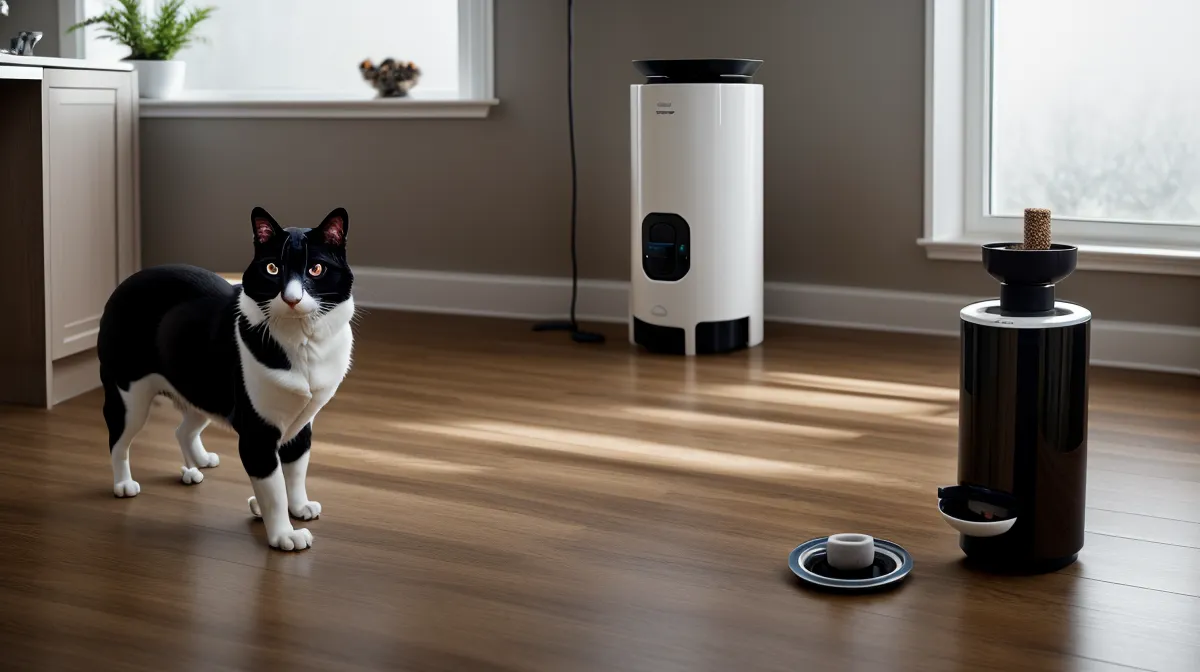
One Tuesday evening last November, I was buried in a Figma file for a client who thinks 'urgent' is a personality trait. Outside, a classic Denver windstorm was trying to peel the siding off my apartment. Then, the lights flickered and died. My first thought wasn't about the unsaved design work; it was about the two hungry faces likely staring at a dead piece of plastic in the kitchen.
Quick disclosure: some of the brands I mention here send me a commission if you buy through my links. I earn a commission at no extra cost to you, but keep in mind I buy this gear with my own freelance income and stress-test it in my own kitchen. If Hopper and Beans don't like it, it doesn't make the cut, regardless of the kickback.
Hopper is my 9-year-old tabby, and he has the internal clock of a Swiss watchmaker. Beans, my 4-year-old ragdoll mix, is more of a 'vibes' guy, but even he gets cranky when the kibble hitting the bowl doesn't provide that evening percussion. Back in 2023, I had a cheap feeder jam while I was at a late dinner. I came home to a 'furious cat' situation that involved shredded toilet paper and a look from Hopper that suggested I was lucky to be alive. That was the day I decided to stop buying whatever was on sale and start looking for gear that actually works when the grid doesn't.
The Great Jam of 2023 and the Search for Sanity
When you work for yourself, your schedule isn't yours. A mid-afternoon check-in becomes a four-hour strategy session, and suddenly it's dark, you're three miles away, and you're praying the Wi-Fi didn't hiccup. A feeder jamming is like a dishwasher getting stuck mid-cycle—it's messy, annoying, and usually happens exactly when you have the least amount of time to deal with it. For me, the stakes are higher because Hopper has some specific digestive needs that require small, frequent meals. If he misses one, he doesn't just get hungry; he gets sick.
Most people look at smart feeders and see convenience. I look at them and see a single point of failure. After the 2023 disaster, I spent months researching local scheduling versus cloud reliance. I realized that if a feeder needs a constant heartbeat from a server in another country just to drop half a cup of food, it's not a smart device—it's a liability. I needed something that would keep its brain even if the router was screaming for help.

That search led me to the Petkit system. It has a 4.4 user rating for a reason, and it's not just the sleek design. The big selling point for me was the dual power supply and the way it handles its internal clock. It wants a 2.4GHz Wi-Fi connection for the initial setup—which is standard because that frequency has better range for punching through the thick walls of my older suburban rental—but once that schedule is synced, it lives on the device hardware.
The Real-Time Test: November's Windstorm
Back to that stormy night. My laptop battery was holding steady, but the house was silent and the router was a dark brick. I pulled up my phone, switched to cellular data, and waited. Within seconds, a notification popped up from the Petkit app. It didn't just tell me the power was out; it confirmed the feeder had switched to its D-cell battery backup and that the scheduled 6:00 PM meal had been dispensed successfully.
That is the kind of peace of mind you can't put a price on when you're stuck in a meeting. I've found that dual-power feeder stress tests are the only way to know if you can actually trust the marketing. The Petkit uses a stainless steel bowl, too, which is a big deal. Plastic bowls are porous and trap kibble grease, leading to 'feline acne.' Stainless steel just rinses clean, like a good frying pan. If you're interested in how I've layered these devices, you can check out my notes on keeping the peace when meetings run late.
But the real test came the following morning. The power was still out. The backup battery was still holding. Usually, when the power cuts, these 'smart' gadgets forget who they are. They're like a toddler who lost their shoes. But this unit just kept ticking. It didn't need to ask the cloud for permission to feed my cats. It just did its job.
When 'Good Enough' Isn't Enough: The Medical Angle
Here is where I get a bit serious. For most cats, a late meal is a nuisance. But for owners of pets with complex medical needs—like those dealing with feline diabetes or strict medication schedules—a missed feeding is a veterinary emergency. Standard automated feeding often fails here because most brands don't guarantee the precise, medication-dependent dosing needed. If your cat needs to eat exactly 30 minutes after an insulin shot, you can't have a feeder that 'occasionally' drops a meal an hour late because the Wi-Fi was laggy.
I’ve talked to neighbors who have pets on high-stakes diets, and they all have the same fear. They buy a feeder, it works for a week, and then it misses a drop. In my testing, the Petkit was the only one that felt like it was designed with that level of consequence in mind. It doesn't just 'try' to feed; it logs the success locally. For a freelancer who might be across town when a medical window opens, that's the difference between a productive workday and a panicked drive to the ER.
I also keep a Petlibro feeder as a secondary unit in the living room. It's a great 'Best Value' pick, and the kibble portioning is surprisingly accurate. However, during that same outage, the Petlibro lost its Wi-Fi connection because my router was two rooms away. While it still fed the cats (thankfully), the notifications were delayed by nearly an hour once the power came back. It's a solid backup, but for the 'must-work-no-matter-what' primary meal, the Petkit stays in the kitchen. If you're curious about that specific model, I wrote about why the Petlibro works for Beans and his specific eating habits.
The Five-Month Reflection
By mid-January, I had been using this setup daily for months. I’ve logged every 'skipped' heartbeat from my router and every flicker of the Denver grid. After about a month of daily use, you start to see where the cracks are. Cheap feeders start to sound like a grinding garbage disposal. The seals on the food hopper start to loosen, making the kibble stale. Cats are crepuscular animals, meaning they are most active at dawn and dusk. That’s exactly when I’m usually either starting my first cup of coffee or finishing a client call. If the food isn't fresh, Hopper lets me know by knocking things off my nightstand.
I even tested some comfort gear during the colder months. I picked up an orthopedic bed from FunnyFuzzy because Beans likes to knead everything in sight. Their memory foam has a 4-month shape retention period that actually holds up; most cheap beds flatten out like a pancake after three weeks of a 12-pound ragdoll mix sleeping on them. It’s not a feeder, but it’s part of the 'I'm not home' ecosystem that keeps them from destroying my apartment while I'm working.
Look, I’m not a behaviorist. I’m just a guy who tired of coming home to a 'stuck dishwasher' of a feeder and two cats who looked like they were planning a mutiny. If you’re a freelancer, or just someone who can’t always be home by sunset, stop looking at the app features and start looking at the hardware backups. Does it have a battery? Does it have local memory? Does it have a bowl that won't give your cat a rash? If the answer is no, keep looking. Your Figma files—and your cats—will thank you.
If you're looking to build a system that won't quit on you, I'd suggest starting with the Petkit for your primary meals. It's the only one that survived my 'nobody's home and the power is out' stress test without breaking a sweat. For the smaller stuff like filters or bulk grooming supplies, I usually hit up Revival Animal Health—they’ve got the deep inventory that big-box stores don't touch. Just make sure you're setting everything up on that 2.4GHz band, or you'll be fighting the setup process longer than the actual feeding.