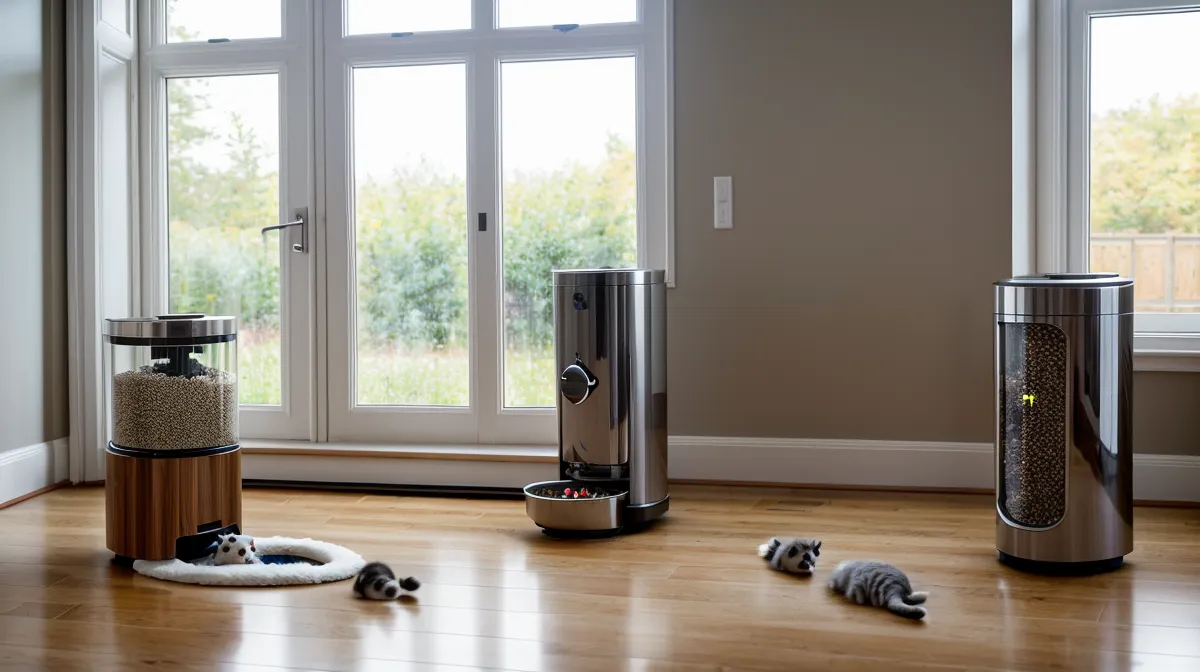
What actually happens inside a hopper the instant it splits into two chutes for two cats who eat at completely different speeds? That question decides whether a multi-cat feeding setup holds up or turns into a referee job. I test pet tech gear the way most people test a mattress — by actually living with it for weeks, not by reading the box — and the two-cat divider tray is the one part of this whole category that either works quietly in the background or announces its failure the second one cat finishes and the other hasn't started.
Before any of the mechanical stuff, there was the manual version. Portioning Sunday meal-prep containers into the fridge for the whole week — one per cat, per day, neatly labeled — sounded foolproof until Wednesday actually arrived. A long client call doesn't care that Tuesday's container already got pulled and eaten, and "I'll feed them the second this meeting ends" turns into forty-five minutes late often enough that I stopped trusting myself with the job.
That's really why any of this automatic gear earns a place in my kitchen at all: the test that matters isn't a quiet evening at home, it's a full workday, or a few unattended hours on a weekend spent on the running paths at Confluence Park along the South Platte, phone in my pocket, hoping the last thing I set up actually held.
The Divider Notch Is Where Two-Cat Feeding Setups Actually Fail
Look, the divider itself is just a plastic fork that splits one stream of kibble into two paths, nothing exotic, nothing that should need a manual, and almost every dual-tray feeder on the market uses some version of it, usually while a stray patch of cat fur drifts across my keyboard as I read the instructions. The part nobody mentions on the packaging is that it only works if it's actually seated into its notch, not resting near it, not close enough to look right. If that divider isn't clicked fully into place, gravity takes over and does whatever it wants: one side gets fed generously, the other gets whatever spills over. I've watched an entire pour go lopsided because the divider looked seated but wasn't, and there's no app notification for that. You find out because one cat is circling an empty bowl.
Why Does the Wall Between Bowls Make One Cat Anxious?
A divider does more than split food — it also cuts off sightlines, and that's not a small thing in a multi-cat household. Head-down in her bowl, one cat can't track what the other is doing on the far side of that plastic wall, and that blind spot creates its own tension. A barrier like this can quietly work against a cat by blocking peripheral vision, which is exactly the sense that keeps most cats calm while eating near another animal. Beans is the one who reacted to it during my testing — she'd stop mid-bite every few seconds just to lean sideways and check that Hopper wasn't circling around for a second helping, which is its own kind of stress even when nothing was actually happening. Moving the feeder a few inches from the wall, so both cats had a clear line of sight and an exit path on either side, took most of that edge off.
Bowl Material and Depth, Independent of the Split
None of that divider engineering matters much if the bowls themselves work against you. Stainless steel is the only material I'll put kibble or water in at this point — plastic scratches, and those scratches turn into a breeding ground for the bacteria behind feline chin acne, which is a preventable vet visit if you just skip plastic from the start. Depth matters just as much as material. A bowl that's too deep forces a cat's whiskers to brush the sides with every bite, and that sensory overload — whisker fatigue, if you want the term — makes cats paw food out onto the counter just to avoid dipping their whole face in. Shallow, wide, steel. That's the whole spec sheet that actually matters here.
Weighing the Split Before You Trust It
Portion controls on feeders like this are usually fine enough to dial in a meal size precisely, and the number on a screen means nothing until you've actually weighed it. I ran a kitchen scale under a handful of manual-feed cycles for both sides, back to back, because a portion count on an app and actual grams landing in a bowl are two different claims — and somewhere behind me during one of those cycles, the water fountain across the kitchen sputtered down to its last inch and started gurgling on air, with Hopper wandering straight over to bat at the faucet out of pure habit, because testing more than one gadget in a small kitchen means something is always making noise while you're trying to concentrate on something else. The one place the scale actually caught a drift was when the hopper ran low: once you're down near the bottom, weight distribution shifts, and the internal infrared sensor will flag the food as low, but that doesn't guarantee the divider still has enough kibble weight above it to push both chutes evenly. Weigh a cycle near empty, not just near full, or you won't catch the side that quietly starts shorting one cat.
And if you've got a cat determined enough to override any of this by force, that's a separate topic entirely — I've written about how to stop your cat from breaking into an automatic cat feeder elsewhere, because a divider tray solves a food-distribution problem, not a break-in problem.
What This Setup Doesn't Cover
A few things sit right next to this topic without actually being part of it. Getting the per-meal portion number to match what each cat needs by weight is its own calibration problem, separate from whether the divider splits evenly. Wet food runs on a completely different spoilage clock than dry kibble ever will, so none of this divider logic carries over if that's your setup. Water fountains have their own mineral-buildup timeline that has nothing to do with a dry hopper sitting on a counter. Battery backup deserves a longer look than "it takes a few D-cells and that's reassuring" — reliability during an actual power blip is a separate test from anything covered here. Jams happen for reasons that usually have nothing to do with the divider, further up in the chute where the kibble first funnels down. Checking in on a feeding remotely through a camera is a different kind of verification than trusting the mechanism blind. What a feeder actually does the moment Wi-Fi drops entirely, instead of just reconnecting slowly, is its own reliability question. Getting a stable handshake with a router in the first place is a separate headache from anything the divider does. And a desiccant bag losing its fight against humidity is a freshness problem, not a distribution one. Multi-cat separation itself has more than one approach, too — Tomoko, a friend from a local design-and-tech meetup who tests gear on her own three cats without anybody asking her to, has found the physical-divider route breaks down fastest once one cat outweighs or outpaces the other by a wide enough margin, which is when a setup built around individual microchips instead of one shared tray starts making more sense. I ran an earlier stress-test on the Petkit during a 12-hour shift, back before any of this divider testing started, and it's a decent baseline if you want to compare notes on reliability outside the divider question entirely.
Divider Or Two Feeders — The Actual Decision Rule
Here's the actual rule, not the marketing version: a divider works when both cats respect their own side and eat at a roughly similar pace. It stops working the moment one cat is a shoveler who finishes fast and then wanders over to finish the other bowl too, because a plastic fork down the middle of a tray does nothing to stop a cat from walking around it. If that's your household, you're not looking at a divider problem anymore — you're looking at needing two fully separate feeders in two different spots, full stop. But for two cats who generally hold their own lane, the split-tray approach removes the single biggest daily friction point in a multi-cat kitchen: the standoff at dinner, one cat finished and smug, the other still waiting on their half. Get the notch clicked, weigh a cycle near empty, watch which cat gets nervous about sightlines, and the rest of it holds together without much fuss.